The information you need can be searched for from here

CLOSE ✖
POINT!

Appeal of Akigawa Valley nature experiences
Rivers are not just for viewing. They are places where you can feel the water and wind on your body.
The Akigawa Valley nature-experience program is designed to give people with disabilities, elderly people, and their families and caregivers the opportunity to enjoy spending time in a riverside environment.
Thanks to the use of special equipment and support systems, even people who have felt anxious about approaching rivers in the past can safely experience the natural environment of clear streams.

Akigawa Valley Nature Experience
(Chairing, River Fishing & SUP Experience)
Monitor Tour

Tokyo is promoting the creation of a tourism environment that enables anyone to safely enjoy nature, including people with disabilities and elderly people. As part of these efforts, a nature-experience trial tour was held in Akigawabashi Kasen Park, which is in Akigawa Valley, Akiruno City. This article introduces the event.

Movie

Contents

Overview of the Akigawa Valley nature-experience trial tour

On September 10, as part of its Fiscal 2025 Nature Experience Tourism That Everyone Can Enjoy, Tokyo held a trial tour, the Akigawa Valley Nature Experience (Relaxing in a Chair Outdoors & River Fishing & SUP Experience): Management Experience to Support People with Disabilities, in Akigawa Valley, Akiruno City.
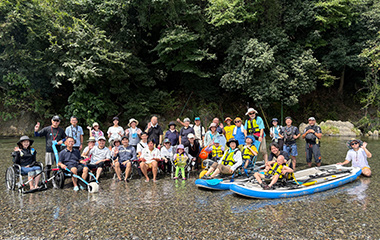
The trial tour’s participants included people with disabilities, their caregivers, travel agency employees, and business operators who provide nature-experience-based learning in the city.
The instructor was the following promoter of accessible tourism initiatives throughout Japan:
・Mr. Masami Nagahashi, Chairman and Chief Researcher,NPO Universal Tourism Research Institute This experience used a one-day training format.

The group photo of the test tour participants.

Event venue

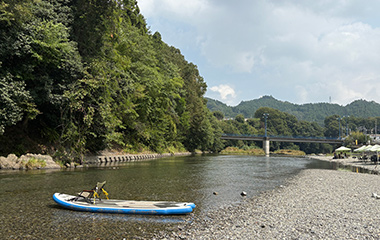
The event venue was Akigawabashi Kasen Park, which is located in Akiruno City, Tokyo, and is a natural attraction typical of Akigawa Valley. Just ten minutes by car from Musashi-Itsukaichi Station (JR), the park is easy to access and offers an open environment complete with a clear stream and surrounded by greenery.
The riverbank has a relatively gentle slope, there are many places where the waterside can be easily approached, and the park has its own restrooms and rest areas. In addition, the river’s current is calm in certain places, so visitors can dip their feet into the shallow water, and the park’s environment makes it easy to enjoy nature walks or playing in the river.
The park is also appealing in terms of its location, which is only about an hour and a half from the city center by train and car, and is therefore a great option for even a one-day trip.

The scenery of the Akigawa riverbank.

Nature-experience preparations

To enable participants to safely approach the riverside and enjoy playing in the river during their Akigawa Valley nature experience, we used special equipment. This equipment was transported to the location in advance in preparation for safe management on the day of the event.
The main equipment used during this experience is introduced below.
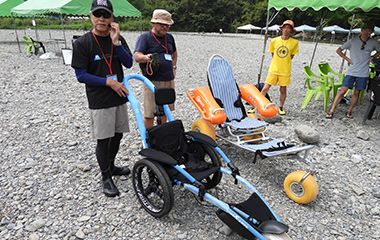
1) Outdoor wheelchairs (HIPPOcampe)
These outdoor wheelchairs are capable of stably moving in riverbank environments, which include gravel and grade differences, and are therefore important for supporting movement to the riverside. Outdoor wheelchairs:
・Have thick tires unlikely to sink in gravel roads, ・Vibrate little, which helps users feel secure, and ・Boast a design that makes it easy for caregivers to walk nearby. During the event, these wheelchairs provided initial support to help people approach the river in spite of the unsteady footing in the riverbank environment.
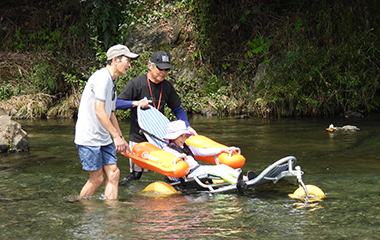
2) Amphibious wheelchairs (Mobi-Chair)
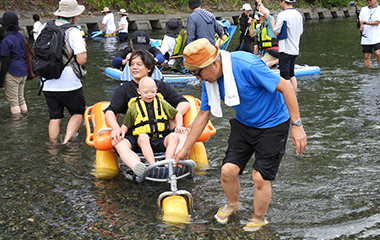
These special amphibious wheelchairs can be used both on land and in the water. They float on the surface of shallow water to offer users the ability to directly experience rivers. Amphibious wheelchairs:
・Can stably float thanks to buoyant wheels and armrests, ・Can smoothly move from the riverbank to the waterside, and ・Give users the chance to directly experience the coldness and current of the water. Unlike normal wheelchairs, amphibious wheelchairs gave participants the opportunity to safely enjoy the feeling of surrendering themselves to the water during the event.
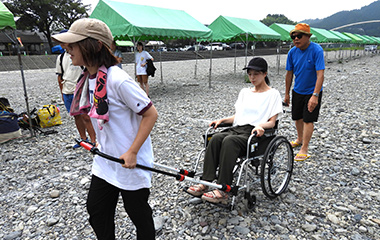
3) Wheelchair pulling equipment (JINRIKI)
This pulling equipment can be easily attached to wheelchairs and makes it easy to move even on gravel roads and gradually sloping hills with little force. This equipment:
・Is effective in places where pushing is difficult, ・Lightens the burden imposed on caregivers, and ・Reduces vibrations and enables more stable movement. During the event, this equipment helped participants more securely navigate the ups and downs of Akigawa Valley’s road to the riverbank.

Outdoor wheelchairs (HIPPOcampe)

HIPPOcampe

Wheelchair pulling equipment (JINRIKI)

JINRIKI

Nature-experience details

For the Akigawa Valley nature experience, three programs were set up, and experts were appointed to provide guidance so that participants could safely approach the riverside and enjoy playing in the river.
1) People with disabilities experiencing entering the water
As described above, HIPPOcampe, Mobi-Chair, and JINRIKI equipment was used to enable supporters to guide people with disabilities from the riverbank to the river so they could enter the water. This was an extremely valuable opportunity for people who had never gone into a river before to safely enter the water with their supporters, and this experience was extremely popular with participating children in particular.
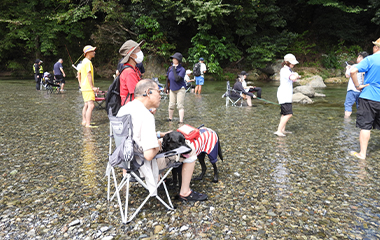
2) Relaxing in a chair outdoors (“chairing”)
Wheelchair users and visually impaired people took on the challenge of “relaxing in a chair outdoors.” Chairing is a leisure activity where you take a folding chair or outdoor chair outside and sit wherever you like. It is a portmanteau of "chair" and "-ing" (expressing an action). There is no need for special equipment, and as long as you can set up a chair outdoors, anyone can easily enjoy the outdoors in a park or by a river. Because this activity involves setting up chairs on the waterside and participants dipping their feet in the water, it is important to confirm the stability of the chairs in advance as well as nearby stones on the ground. The staff members and caregivers therefore collaborated to choose locations where chairs would not tip over as they set up camping chairs. In addition, HIPPOcampe, Mobi-Chair, and JINRIKI equipment was used to enable multiple supporters to help each participant sit in a way that would not cause them undue stress. Relaxing in a chair outdoors in this way gave participants the chance to more intimately experience the natural river environment by feeling the coldness of the water and listening to the babbling sound of the water.
3) River fishing (traditional Akigawa-style minnow fishing) experience
This experience was provided with the guidance of staff members from Tokyo Mountainside DMC, which runs an inquiry-based nature-experience learning school and offers adventure travel services. During this experience, participants collected river insects from river stones to use as bait. They then enjoyed relaxing in chairs as they took on the challenge of fishing for minnows. Both adults and children therefore had the chance to enjoy river fishing using simple tools (short fishing rods, fishing lines, and fishhooks).
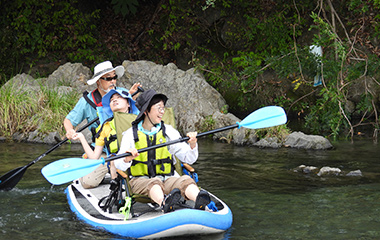
4) SUP experience
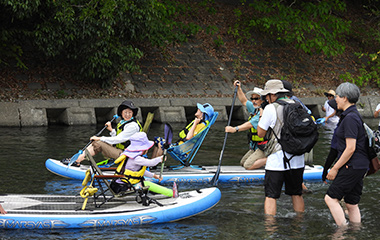
This experience was provided in collaboration with Bochibochi Adventure Susono, which offers outdoor tours that include canoes and SUP in Okutama. Wheelchair users and visually impaired people took on the challenge of experiencing SUP by using a large SUP boat equipped with a securely fastened low camping chair with armrests. The business operator in charge of providing the SUP experience program also acted as an instructor to help participants learn how to paddle, enabling some participants to experience SUP rowing for themselves. In cases where people with disabilities struggled to row on their own, caregivers rode with them so they could enjoy SUP experiences as well.

The scene of entering the river in an Amphibious wheelchairs (Mobi-Chair).

Mobi-Chair

The scene of wheelchair users and visually impaired people took on the challenge of "Chairing"
The scene of wheelchair users and visually impaired people trying out the "SUP experience" on a large SUP boat.

Enabling everyone to share the joy of spending time at a river

Once the preparations were complete, the participants slowly made their way to the waterside along with their caregivers and the staff.
Everyone used outdoor wheelchairs and other assistive devices as they confirmed the nearby stones on the ground and strength of the current while carefully approaching the river.
・Multiple people supported each participant, putting safety first as they confirmed the water depth and river current as needed. ・The basic approach was to provide multiple short experiences that did not put undue stress on participants, paying close attention to their physical condition and level of fatigue. Once participants sat down in the chairs and dipped their feet in the water, they naturally started smiling as they enjoyed the feel of the river’s refreshing coolness.
“The water’s coolness felt so good, and I was so glad I came.”
“I had no idea that sitting together along the side of a river could be so much fun.”
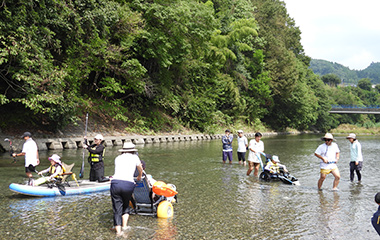
Even people who had hesitated to go into a river until then finally had the chance to experience the pleasant babbling sounds of the water and the wind, and they shared this special time with their caregivers. For them, this event changed rivers from “places to be gazed at from afar” to “places where you can spend time together”, enabling them to naturally experience this change.

The scene of entering the river in an Amphibious wheelchairs (Mobi-Chair).
The scene of wheelchair users and visually impaired people trying out the "SUP experience" on a large SUP boat.
The scene of enjoy playing in the river.

The site below introduces accessibility information related to tourist facilities in the Tama area.
Be sure to take a look at it as well.
https://www.sangyo-rodo1.metro.tokyo.lg.jp/tourism/accessible/en/23city_tama/

Main Page return to
top of
page.