The information you need can be searched for from here

CLOSE ✖
POINT!

The sea is not just for viewing. It is a place where people can get in and play.
The sea is not just for viewing. It is a place that can be experienced. Accessible beach initiatives are aimed at enabling not only people with disabilities and elderly people but also their caregivers and companions to experience the natural environments of beaches.
With the right special equipment and support systems, the anxiety associated with beaches, which are generally viewed as difficult to access, can be eliminated, and these places can then be presented as travel packages that enable anyone to safely share the appeal of the sea.
The sea tends to be viewed as a “dangerous place that is hard to visit” by people with disabilities, but, with the necessary equipment and operating procedures in place, such locations can be transformed into “places that can be safely enjoyed.” The ability to shift values is the essential power of accessible tourism.
Shifting values from “viewing” to “participation” also enables business operators to provide experiential value that can be enjoyed alongside caregivers and companions. This also greatly expands the potential of the tourism business, including exploring new customer segments, creating a wider range of products, and contributing to the building of systems for cooperating with local guides and transportation operators and accepting customers.
Key implementation points
・Access: To enable wheelchair users to safely move, confirm the user flow from the parking lot to the beach and water’s edge. Make sure you have a clear understanding of factors affecting safety and comfort, including slopes, differences in grade, shady locations, and the hardness of the road surface. ・Showers: Prepare chairs that can be used even if participants get wet, and set up an environment that enables showering in a comfortable position. Also consider user needs in terms of the positions of handrails, how slippery the floor is, towel racks, etc. ・Space for changing clothes: Secure enough space for users to lie down while changing their clothes, and, if this is not possible using on-site facilities, consider alternative facilities. It is also important to ensure enough space for assistance as well as privacy. In addition, when changing wetsuits, it is necessary to provide shelter from the wind and shade, set up anti-slip mats and other measures to keep the floor safe, implement a flow that considers how long it takes to change, and take heat retention measures. ・Restrooms: Make sure you know whether there are restrooms accessible to wheelchair users, where they are located, and whether they can actually be used. Confirm relevant details in connection with safety, including how much space there is inside restrooms, the directions doors open and close in, and the positions of handrails. Operating tips
Confirm the existence of differences in grade, slopes, and the road surface situation by mapping the flow of people: reception → changing clothes → beach → entering the water → showering → changing clothes → disbanding. If there is a shortage of equipment, also consider utilizing nearby alternative facilities, temporary space, etc. In addition, on the day of the event, adjust the experience time and number of rest breaks according to weather conditions (the temperature, wind, and waves), and strive to ensure the safety and comfort of participants.

Hachijojima Accessible Beach and Snorkeling Experience Workshop & Monitor Tour
Nature Experience Tourism Promotion Project that everyone can enjoy

Tokyo is promoting the development of a tourism environment that enables anyone to safely enjoy nature, including people with disabilities and elderly people. During the Hachijojima Accessible Beach Management Experience Workshop, which was held in Hachijojima on July 10 and 11, 2025, business operators and participants had the chance to learn about and experience the technology and operating procedures necessary to provide safe nature experiences.

Movie

Contents

Overview of Hachijojima Accessible Beach

The wide range of participants included people with disabilities, their caregivers, travel agency employees, and nature-experience business operators. The instructors were Mr. Masahiro Sakakibara, Chairperson of the Shonan Barrier-Free Tour Center, which handles accessible beaches throughout Japan, and Ms. Yuriko Orui, Representative of Shinoki, which provides nature-experience tours in Hachijojima, and overnight training (two days and one night) was provided.
The venue, Sokodo Beach, has good access given its location approximately one hour from Haneda Airport, and the sea conditions there are relatively calm, which makes the environment suitable for accepting a diverse range of participants. Another important point is that the chosen site has the right conditions for enabling wheelchair users, elderly people, and others who require mobility-related consideration to easily participate.

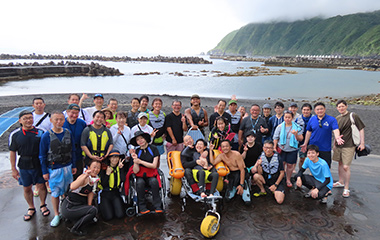
The group photo of test tour participants in accessible beach.

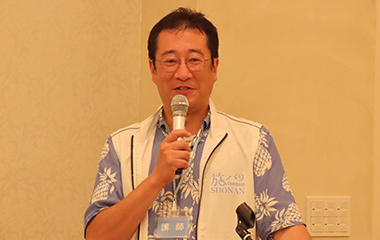
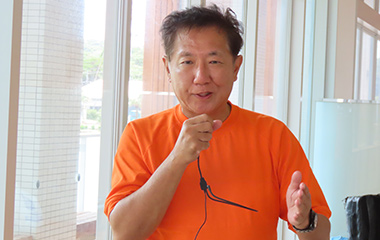
Workshop lecture: Mr. Masahiro Sakakibara, Chairperson, Shonan Barrier-Free Tour Center

Mr. Sakakibara introduced five kinds of barriers that stand in the way of accessibility: “physical, system, cultural, information, and awareness.” He emphasized that it is necessary to comprehensively address these barriers to achieve accessible nature experiences.
According to him, it is especially important to call out to participants on site, and he shared three basic steps for offering them peace of mind: “Is there anything I can help you with?” “Are you having any trouble?” “Is there anything I can do?”
Mr. Sakakibara also explained that business operators in charge of management can help to ensure safety and comfort by focusing their preparations on four topics: parking lots → showers → changing clothes → restrooms.

Photo of Mr. Sakakibara

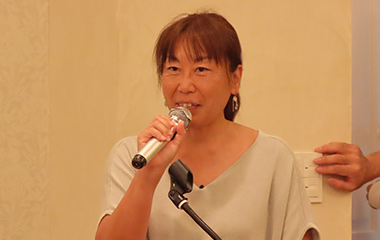
Workshop lecture: Ms. Yuriko Orui, Representative, Hachijojima Nature Guide Service Shinoki

Ms. Orui explained that, based on her experience dealing with diverse participants, including people with intellectual, visual, or hearing impairments as well as wheelchair users, the main key when it comes to the sea is to provide suitable support related to breathing, balance, and buoyancy.
She also introduced many kinds of know-how that business operators can utilize on site, including how to adjust experience details according to the physical strength, experience, and anxiety level of each participant as well as how to clarify the feasibility judgment standards according to the weather and sea conditions.

Photo of Ms. Orui

Training session (1): nature-experience planning procedures (planning → previewing → verification)

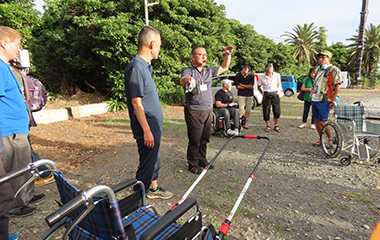
Mr. Tomohiro Fuchiyama, an accessible tourism advisor, emphasizes that, when it comes to planning experience-based nature tourism, it is essential to carefully proceed in three stages: hypothesis → previewing → verification. In terms of Hachijojima Accessible Beach, he started by formulating a hypothesis: “Is Sokodo Beach a feasible site?” During the preview, he confirmed details that included determining whether wheelchairs can be used to approach the beach, whether the distance to the water’s edge is suitable, and whether restrooms, changing rooms, and rest areas can actually be used. In particular, the changing room was judged to be unsuitable because it had stairs, and the decision was made to use the changing room at the Sokodo Campsite, which was approximately 250 meters away, instead. In addition, during the verification stage, an on-site trial run was conducted, including the flow of people from reception to changing clothes, entering the water, and taking a shower, the positions and roles assigned to personnel necessary for safety, equipment setup and procedures, and the wireless and mobile communication situation, to calculate the necessary time and identify risks, which were then applied to management on the day of the event. According to Mr. Fuchiyama, this series of steps shows the importance of focusing not on “whether equipment exists” but rather on “whether equipment can be safely used by participants” during planning, and the information taught turned out to be a set of practical guidelines for business operators that will create nature-experience programs in the future.

The scene of Mr. Tomohiro Fuchiyama giving an explanation.

Training session (2): operational flow on the event date (setup → experience → withdrawal)

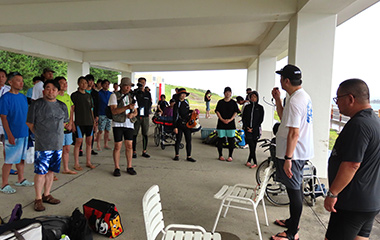
In terms of management on the event date, by following a flow that consisted of (1) briefing (around 10 to 20 minutes, weather confirmation, role assignment, and safety information sharing) → (2) setup (around 30 to 60 minutes, access mat setup, waiting and rest area positioning, and equipment preparation) → (3) experience (around 30 to 90 minutes, support after entering the water and rest breaks during the event) → (4) withdrawal (around 30 to 60 minutes, changing clothes, shower guidance, equipment cleaning and inspection, and sharing what was learned), it was possible to achieve safe, highly reproducible accessible-beach management. First, during the briefing, staff members shared information on the weather, wave situation, dangerous locations, the status of participants, the division of roles, procedures for responding to emergencies, and other details to ensure that everyone could take action based on the same assumptions. Meanwhile, during the setup stage, everyone set up access mats from the embankment to the water’s edge, established the flow of participants, and safely positioned rest and waiting areas. During the experience stage, suitable equipment and assistive methods were selected according to the disability characteristics and physical conditions of participants, participants were handled using a multiple-person system that included a pusher, people who provided support from the left and right, and a safety supervisor, and the tide, waves, and fatigue of participants were constantly observed. During the withdrawal stage, the flow of people to areas where they could change their clothes and shower was confirmed as equipment was cleaned, inspected, and put away, and everyone shared possible points of improvement for next time. The flow presented by Mr. Fuchiyama, which involves “preparing step by step and then safely handling each process,” is a practical procedure for business operators to use to take full advantage of site characteristics when they design and manage nature-experience programs in the future.

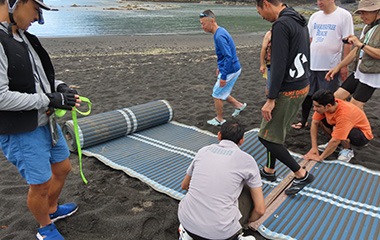
The scene of briefing.
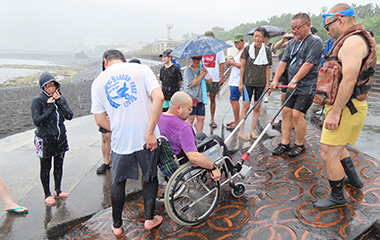
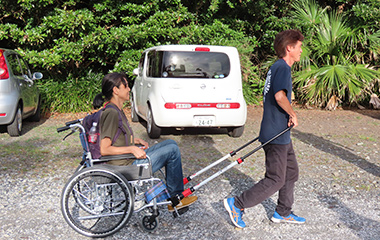
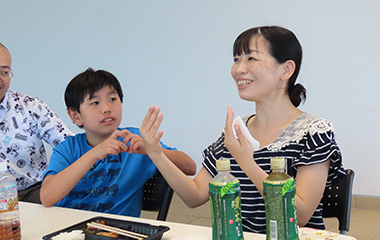
The scene of descending to the beach using the wheelchair pulling equipment (JINRIKI).
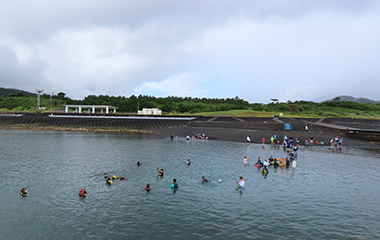
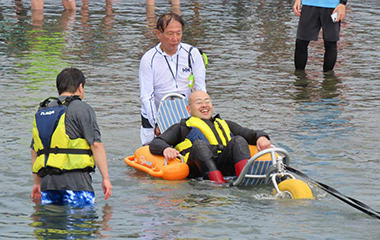
The scene of enjoy playing in the beach.

Business operators supporting the trial tour

【Hachijo View Hotel】
This resort hotel is located on a hill in Hachijojima (Izu Islands, Tokyo). Only five minutes away from the airport by car, the hotel is easily accessed and offers a spectacularly appealing view of Mount Hachijo-Fuji and the Pacific Ocean. The hotel also offers accessible accommodations that consider the needs of wheelchair users, elderly people, and other travelers who require support, including flow lines through the building that have few differences in grade, elevators, handrails, and accessible guest rooms and restrooms.
【Hachijojima Nature Guide Service Shinoki】
This organization is familiar with the local sea conditions, terrain, tides, and other details, which enabled it to play a key role in terms of both managing safety and explaining the natural environment during the event, including making experience-level adjustments according to the physical strength and anxiety of each participant. This organization works to ensure that nature experiences go beyond simply “playing in the sea” and instead offers “programs facilitating learning and discovery.”
【Minkan Kyukyu Feel】
This organization was in charge of providing paramedics and nurses capable of managing the physical condition of participants, judging emergencies, and handling transportation. The involvement of such healthcare professionals increased the peace of mind enjoyed by participants and their families, while also giving business operators an opportunity to gain practical insight into risk management associated with accessible tourism. The organization also has lift-equipped vans that can be boarded by people in wheelchairs, which helps make it possible to flexibly handle situations where multiple people ride at the same time as well as groups. Although it is necessary to confirm the number of available vehicles and number of passengers in advance, the organization’s system enables transportation to be secured according to the status and scale of participants.
【Significance of cooperation】
Business operators do not handle management on their own. Instead, they cooperate with specialized local guides, medical institutions, and tourism operators to achieve advanced safety and experiential value. Complementing the expertise of business operators in this way increases the sustainability of accessible tourism.

Utilized assistive devices and how to use them (Mobi-Mat / Mobi-Chair / JINRIKI)

The three types of assistive devices below were used during accessible beach management. At the workshop, everyone confirmed the role of each device and how to use it on the actual site. Note that this equipment was transported from the mainland to the island by ship, so this event served as a practical example of how to systematically transport assistive equipment to a remote island in order to set up an accessible environment.
1) Access mats (Mobi-Mat)
These mats help to prevent wheelchairs from sinking when used in rough terrain such as beaches, and they were recently used to create a path that enabled safe movement from the embankment and ramp exit to the water’s edge. The necessary length was calculated based on a preliminary inspection, and it was also important to first smooth out the sand to secure a continuous path. For this event, two Mobi-Mats were connected together and set up to secure a path to the coast. Note that these mats were transported from the mainland to the island by ship, so this event enabled us to confirm that, by determining the necessary number of mats and shipping them in, it is possible to set up an accessible path similarly to on the mainland.
2) Amphibious wheelchairs (Mobi-Chair)
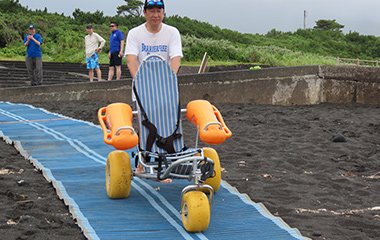
These amphibious wheelchairs can be used both on land and in the water, including rivers, beaches, lakes, and pools, and their wheels and armrests incorporate buoyant material to ensure consistent buoyancy, which enables support from the beach to the sea with only one kind of equipment. Therefore, by having caregivers push such wheelchairs, they enable participants to safely enjoy the experience of floating on the surface of the sea. The key points in terms of using these wheelchairs are as follows: (1) When entering the water, have multiple people provide support, including people positioned to ensure that the wheelchair does not lose its balance and tip to the left or right. (2) Confirm the status of the tide and waves, and make sure the experience only covers a short, reasonable distance.
3) Wheelchair pulling equipment (JINRIKI)
This pulling assistive device can be easily attached to normal wheelchairs and makes it easy to move even on gravel roads, beaches, hills, and other places where pushing is difficult by taking advantage of light pulling force, thereby making movement more stable.
By suitably combining these three assistive devices, we demonstrated that it is possible to establish an “accessible movement and experience flow” that ensures participant safety and a smooth experience, including movement from the parking lot to the beach, from the beach to the sea, and the act of floating in the sea itself.

Access mats (Mobi-Mat)

Mobi-mat

Amphibious wheelchairs (Mobi-Chair)

Mobi-Chair

Wheelchair pulling equipment (JINRIKI)

JINRIKI

Key points on setting up the necessary environment

When setting up an accessible beach, it is important not only to prepare assistive devices but also to set up a suitable environment and share information in advance.
・Photos of the flow of people as well as diagrams that make it easy to understand whether there are differences in grade, the distance, the road surface situation, and similar details ・Disclose information on the website, etc. so that participants can gain an advance understanding of safety. ・Take care of details that include the following and provide information on them to participants: securing changing rooms, shade, and areas sheltered from the wind and confirming the shower water pressure and temperature. Setting up such an environment serves as an important foundation for accessible tourism and helps to increase the sense of security enjoyed by participants.

Implementing management (ensuring enjoyment by both participants and caregivers)

Once the flow of people was determined, the participants moved to the water’s edge with their caregivers, and they carefully used amphibious wheelchairs (Mobi-Chair) to enter the water.
Upon entering the water, participants were supported using a multiple-person system that included a pusher, people who provided support from the left and right, and a safety supervisor, and they confirmed the waves and tide while providing careful support. The moment when participants who had given up on the sea finally experienced the lightness of floating in the water brought them a lot of joy, a profound emotion that was shared with their caregivers.
Participants gradually built up their self-confidence through the provided step-by-step program, many of them eventually took on the challenge of snorkeling, and some of them even remarked that the experience of looking into the sea gave them “memories they hoped to tell their families about.”

The scene of entering the sea in an Amphibious wheelchairs (Mobi-Chair).
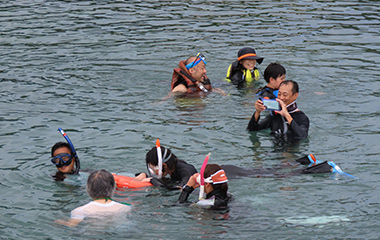
The scene of snorkeling.

After the accessible beach event ended

After the experiences ended, the used Mobi-Mats were withdrawn, and support was provided to enable participants to shower and change their clothes. More specifically, participants safely moved to the changing rooms at the Sokodo Campsite, where they changed their clothes. Because there were wheelchair-accessible restrooms available in the area, it was possible to safely secure flow lines after the experiences.
We then washed, dried, and inspected the used equipment to get ready for the next time it will be used. In addition, immediately after the experience, we recorded participant feedback, facial expressions, and other information that will lead to improved management.

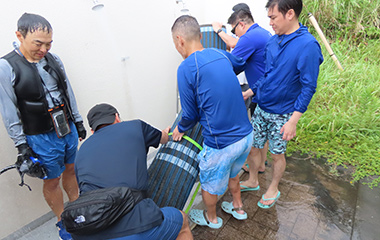
The scene of removing the Access mats (Mobi-Mat).
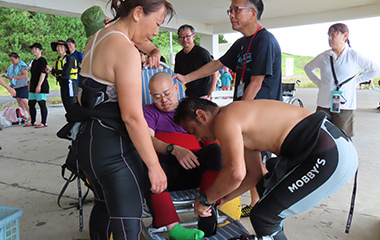
The scene of supporting participants with showering and changing clothes.

Participant feedback

We received feedback from participants that included the following: “Once I understood that, with the right equipment and knowledge, safe sea programs are possible, I felt less anxious.” “I really felt the value of experiences my caregiver can enjoy with me.” “I gained a concrete understanding of the importance of preparing in advance, doing a preliminary inspection, and assigning suitable roles.” This precious feedback shows how important it is to set up environments that enable participants to safely take on challenges as opposed to simply enabling them to enter the sea. In addition, the fact that caregivers also enjoyed the provided sea experiences alongside the participants proves that nature experiences can be fulfilling not only for the participants themselves but also those around them. Furthermore, the fact that the participants themselves experienced and gained an understanding of the importance of “preparations” and the “assignment of roles” has major implications for business operators involved in accessible tourism as well, and this once again highlighted the fact that advance setup and cooperation on the facility and receiving side can profoundly affect the safety of experiences and the level of satisfaction they offer. Such feedback is highly valuable as “real-life lessons” that can be utilized to improve future programs and create new tours and thus has extremely important implications for business operators working on laying the groundwork for nature experiences.

The scene of after the accessible beach event ended.
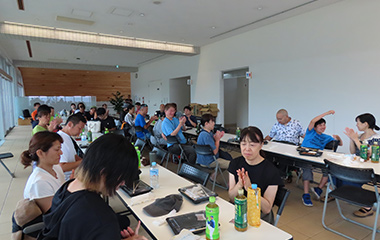
The scene of participants sharing their impressions.

Notes on making arrangements

In addition to sharing information in advance (the status of participants, necessary considerations, and communication systems), it is necessary to confirm movement-related details in advance, including vehicle arrangements, waiting areas, and cooperation related to transportation, as well as restrooms and space to change clothes. Including accessibility information on recruitment pages can also help give participants a sense of security.

Subsidy for Nature Experience Tourism Promotion Project that everyone can enjoy

Access mats, amphibious wheelchairs, wheelchair pulling equipment, and other equipment used to achieve accessible beaches can be introduced by using a subsidy system introduced by Tokyo. This makes it possible to reduce initial costs while providing extremely safe experiences, thereby supporting organizations hoping to enter the experience-based nature tourism business.
Details: https://www.sangyo-rodo.metro.tokyo.lg.jp/tourism/kakusyu/nature/

This trial tour made it clear that even activities once considered too difficult for certain kinds of people to access can be achieved with the right preparation and cooperation.
Little realizations and lessons can serve as a major step on the way to making the local natural environment accessible to as many people as possible.
We hope that you will all apply the seeds of change revealed by this event as you strive to develop your own businesses as well.

Article List return to
top of
page.