The information you need can be searched for from here

CLOSE ✖
POINT!

Mountains are not just for viewing. They can be truly experienced.
Mountains and forests are not just scenery for viewing. They are meant to be explored and experienced on foot. Accessible trekking is an initiative intended to enable people with disabilities and elderly people to share nature-related experiences by taking the same routes as their caregivers and companions.
With the right special equipment and support systems, the anxiety associated with mountain roads, which are generally viewed as difficult to navigate in wheelchairs, can be reduced, and these places can then be presented as travel packages that enable anyone to safely experience the appeal of nature. Mountain roads and unpaved dirt roads tend to be viewed as “dangerous places that are hard to visit” by people with disabilities, but, with the necessary equipment and operating procedures in place, such locations can be transformed into “places where you can safely go.” The ability to shift values is the essential power of accessible tourism.
Shifting values from viewing to participation also enables business operators to provide experiential value by enabling people with disabilities to enjoy the same scenery as family members and caregivers. This also greatly expands the potential of the tourism business, including exploring new customer segments, creating a wider range of products, and contributing to the building of systems for cooperating with local guides and transportation operators and accepting customers.
Key implementation points
・Access: To enable wheelchair users to safely move, confirm the user flow from the meeting place to the course entrance. Make sure you have a clear understanding of factors affecting safety and comfort, including differences in grade, slopes, the road surface (pavement, gravel, or dirt), and the existence of waiting areas. ・Course: Identify any unpaved areas, slopes, narrow areas, and areas where it is difficult to get around in advance. Use equipment (outdoor wheelchairs, pulling equipment, etc.) as appropriate, and design a multiple-person system that includes pushers, pullers, and other support staff to enable everyone to pass through without any undue stress. ・Rest points and rehydration: Set up rest points at suitable locations and with suitable spacing between them, and ensure that they offer shade and shelter from the wind. Also include places to sit and waiting areas in the operational flow so that participants can more easily rehydrate and regulate their body temperature. ・Restrooms: Make sure you know whether there are restrooms accessible to wheelchair users and where they are located. In addition, confirm that any such restrooms can actually be used, including the flow of people leading to the entrance, whether doors can be opened and closed, and space inside them. Operating tips
Confirm the existence of differences in grade, slopes, the road surface situation, and narrow spaces by mapping the flow of people: reception → briefing → equipment preparation → course entrance → trekking → resting → return trip → disbanding. If there are any rough spots, decide how to get through them in advance, and share this information with all the staff members. Depending on the weather and condition of the road surface on the day of the event, adjust the distance travelled and frequency of rest breaks, and regularly confirm each participant’s physical condition. Strive to provide both safety and experiential value by having judgment criteria for deciding when to “go back” or “shorten the event” to avoid overdoing things.

Oshima Trekking Experience Workshop & Monitor Tour: Event Report
Nature Experience Tourism Promotion Project that everyone can enjoy

Tokyo is promoting “Nature Experience Tourism That Everyone Can Enjoy” throughout the city, including people with disabilities and elderly people. During the “Oshima Trekking Experience Workshop,” which was held in Izu Oshima on October 2 and 3, 2025, business operators and participants had the chance to learn about and experience the technology and operating procedures necessary to provide safe nature-walk experiences.

Movie

Contents

Overview of the Oshima Trekking Experience Workshop

The wide range of participants included people with disabilities, their caregivers, travel agency employees, and nature-experience business operators. The instructor was Mr. Masami Nagahashi, Chairman and Chief Researcher,NPO Universal Tourism Research Institute, and overnight training (two days and one night) was provided to give participants the opportunity to learn about support methods and operating procedures for trekking.
Izu Oshima, which was chosen as the venue, can be easily accessed from Tokyo by taking a high-speed jet ferry from the Takeshiba Passenger Ship Terminal, a trip that takes around one hour and 45 minutes, and the volcanic terrain makes for uniquely dynamic natural scenery. This high-speed jet ferry, the SEVEN ISLANDS [YUI], is equipped with special seats, and there is a lift set up on the pier side when getting on or off the ferry in Takeshiba (while Tokai Kisen staff members provide support when passengers get on or off the ship in Oshima), so even wheelchair users can get around relatively easily. An important point about this site is that, in spite of its harsh environmental conditions, including unpaved roads and hills, the site makes it easy for anyone to participate assuming the right assistive devices and support systems are in place, which helps elderly people, wheelchair users, and other people who require mobility considerations.

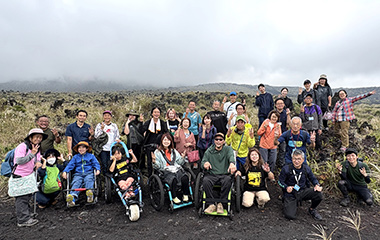
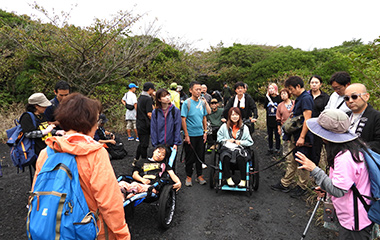
The group photo of the test tour participants.

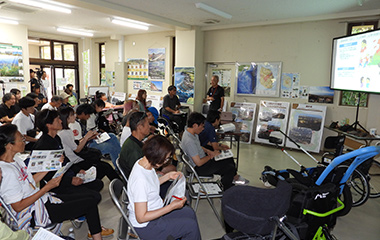
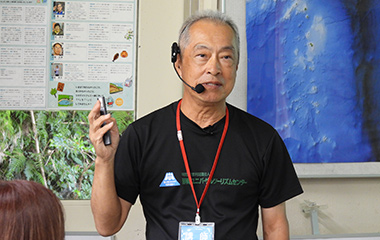
Workshop lecture: Mr. Masami Nagahashi, Chairman and Chief Researcher,NPO Universal Tourism Research Institute

Mr. Nagahashi took the stage, and, based on the topic of “Nature Experience Tourism That Everyone Can Enjoy,” he gave a lecture on how to design trips that enable nature to be shared regardless of disabilities as well as the kind of support and considerations necessary for tourist attractions. He also talked about Tokyo’s approach to accessible tourism, and he described the importance of making “trips that can be experienced together” more common by saying that, “Nature is not intended only for certain people. Instead, nature should be a way for anyone to experience wind, light, sounds, and fragrances in the same way.”
During the lecture, he also introduced examples of accessible tours he has been involved in both in Japan and abroad. He shared stories of experiences during which elderly travelers and travelers with disabilities supported each other as they explored nature, and he emphasized that “traveling has the power to make people think more positively.” Mr. Nagahashi also pointed out that there are four essential barriers that make people hesitate to travel: “physical,” “information,” “system,” and “mental” barriers. He explained that being aware of these barriers is the first step for people involved in tourism if they hope to make progress.
He also touched on the revised Act for Eliminating Discrimination against People with Disabilities as he explained that reasonable accommodation is not something only to be offered in special cases and that it is important to maintain a continuous attitude of achieving such accommodation through dialogue. Next, he introduced specific examples of setting up an inclusive environment for enjoying mountain and nature experiences, including utilizing outdoor wheelchairs and pulling equipment, setting up simple ramps, and creating barrier-free maps. He then concluded his lecture by saying, “In addition to rejuvenating the mind and body, nature experiences boost self-esteem and form connections between people, thereby leading to increased zest for life,” and expressed the role that tourism plays in an inclusive society.

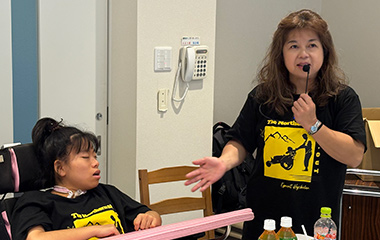
The scene of lecture by Mr. Nagahashi.
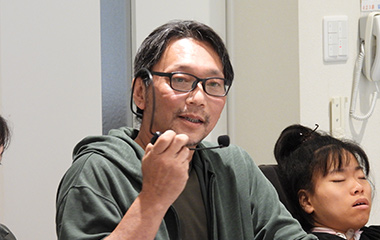
Photo of Mr. Nagahashi

Training session (1): preparing to implement nature experiences

To prepare for trekking in Oshima, we conducted an advance on-site tour with Mr. Fuchiyama, an accessible tourism advisor, to consider the course of the Hot Sprint Hotel Route (a walk from Oshima Onsen Hotel to the Ura Desert), which the Town of Oshima, Oshima Tourism Association, and other stakeholders introduce to give visitors an easy way to experience the appeal of Izu Oshima Geopark. As a result, it was confirmed that the route is accessible to wheelchair users and can be walked by visually impaired people as well. In addition, given that whether a nature trail is easy to walk differs depending on the situation, including puddles caused by the weather, stones, and fallen trees, the companions who intended to provide trekking support checked out the route the evening before the day of the event and then confirmed the route situation again early in the morning on the day of the event.

The scene of Mr. Tomohiro Fuchiyama giving an explanation.
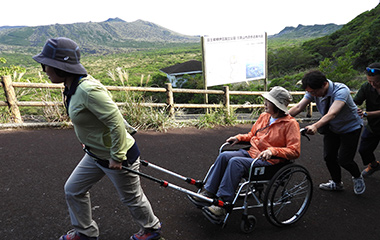
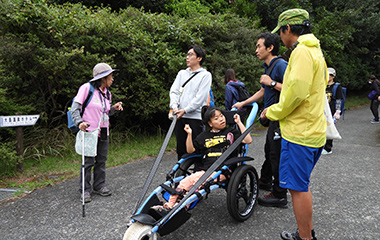
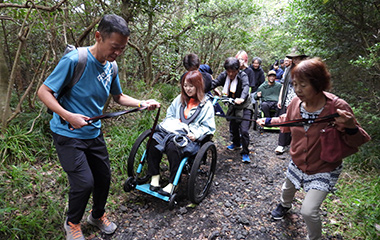
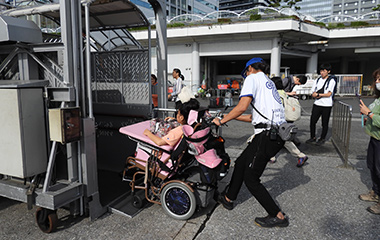
The scene of supporting a wheelchair on a trecking road.

Training session (2): operational flow on the event date

In terms of management on the Oshima event date, the importance of carefully following a flow consisting of pre-event explanations, equipment preparations, experience implementation, and post-completion confirmation was shared. During the pre-event briefing, everyone confirmed information on the weather, wind conditions, course notes, the physical condition and walking pace of participants, the assignment of staff roles, how to communicate during emergencies, and other details due to the importance of all the stakeholders starting the event with the same information.
Meanwhile, during the preparation stage, everyone set up an environment that would enable participants to proceed without any undue stress, including inspecting and positioning assistive devices, confirming the flow of people from the meeting place to the course entrance, and setting up rest areas. During the experience stage, everyone flexibly responded to the situation, including confirming the fatigue of participants and how well they were walking, the status of the ground, the strength of the wind, and other factors as needed, and then responding by reducing the pace and adding rest breaks as necessary. Finally, during the post-completion stage, the staff members collected and inspected equipment, confirmed the physical condition of participants, and shared things they had noticed that day as well as possible points of improvement.
The above flow serves as a practical procedure that business operators can apply on site as is when designing or managing nature-experience programs in the future.

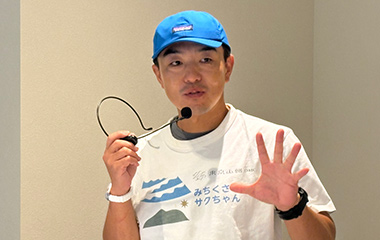
The scene of Mr. Tomohiro Fuchiyama giving an explanation.
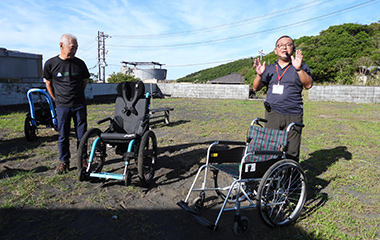
The scene of inspecting wheelchair assistive devices.

Business operators supporting the trial tour

【nicomo】
This company provides mobility products and services specialized in offering mobility support outdoors and for people with disabilities, and, during the recent experience, the company provided wheelchairs to support the safe movement of participants as well as assistive-device operating instructions and was deeply involved in experience-flow creation. In cooperation with local staff members, nicomo kindly introduced methods for utilizing equipment and key points for movement in actual situations, providing support that enabled participants and their caregivers to safely move and enjoy Oshima’s natural environment.
【Oshima Onsen Hotel】
The Oshima Onsen Hotel was in charge of receiving participants and providing them with accommodations and a meeting place. Within the building, the hotel has accessible equipment that considers the movement and accommodation needs of guests, providing them with an environment that offers them peace of mind during their stay. There is also a wheelchair-accessible elevator available to get to the guest rooms on the second floor, and hotel staff members provided support to help guests use it. Meanwhile, on the first floor, where the front desk is located, there are sliding-door-type restroom stalls for both men and women, which make it easy to use wheelchairs and baby strollers, and the hotel also has special accessible restrooms equipped with electronic bidet toilets, handrails, ostomate-oriented equipment, care beds, and baby cribs.
【Oshima Tsubaki】
This camellia oil manufacturer’s history is closely tied to Izu Oshima’s natural environment. The organization considers itself to be a “camellia protecting company” and conducts activities related to protecting, developing and passing the culture derived from camellia and camellia oil on to future generations. At its Oshima Tsubaki Refinery, the company loans out assistive vehicles (with rear swivel seats), power-assisted offroad wheelchairs, power-assisted outdoor assistive wheelchairs, and shower wheelchairs so that anyone can enjoy tourism in Oshima. During the recent trial tour, the company loaned out electric outdoor wheelchairs (eTrike and ePush wheelchairs provided by the Mountain Trike Company, which are described below).
【Oshima Bus】
This company provides public bus, regular sightseeing bus, and chartered bus service in Izu Oshima. As a transportation operator that supports mobility on the island, the company functions as a means for both islanders to get around locally and visitors to get around for tourism purposes. Oshima Bus also has route buses with middle-door ramps that enable wheelchairs and baby strollers to get on and off, and the company’s buses have designated space for wheelchairs and baby strollers as well. During the recent trial tour, the company loaned out low-floor route buses for private use. To request such use, it is necessary to inquire in advance.
【Significance of cooperation】
The involvement of both local companies and transportation operators in the Oshima nature-experience program increased its safety and feasibility. By combining Oshima Tsubaki’s groundwork-laying efforts with the mobility support of Oshima Bus, it was possible to set up an environment that enabled participants to safely get around and enjoy the experience. Such cooperation, which takes full advantage of the expertise of each organization, serves as an important foundation not only for increasing the quality of the experience but also for continuously implementing accessible tourism.

Utilized assistive devices and how to use them (HIPPOcampe / JINRIKI / eTrike / ePush)

During the Oshima trekking experience, a combination of multiple assistive devices was used to help respond to the natural terrain. At the workshop, everyone confirmed the role of each device and how to use it on site while also sharing ways to support the mobility and experiences of participants.
1) Outdoor wheelchairs (HIPPOcampe)
These outdoor wheelchairs can travel on rough terrain, including gravel roads, volcanic lapilli, and unpaved roads, thereby making it possible to move in environments normal wheelchairs struggle with, such as riverbanks and mountain roads. Before use, it is important to preview the travel route, check for the existence of slopes, differences in grade, and narrow spaces, assign pushers and assistants at multiple locations, and ensure that balance can be maintained in all directions when progressing through the area.
2) Wheelchair pulling equipment (JINRIKI)
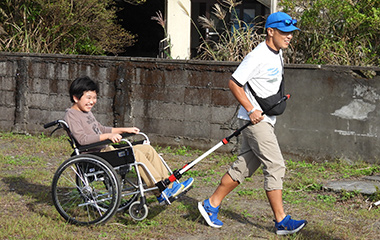
This assistive device can be attached to normal wheelchairs to utilize not only pushing force but also pulling force. This equipment is effective in situations where it takes a lot of effort to advance, such as gravel roads and gradual slopes, and increases movement stability. It is important to confirm the attachment procedure in advance and assign supporting personnel to the sides and rear to improve safety.
3) Power-assisted offroad wheelchairs (eTrike)
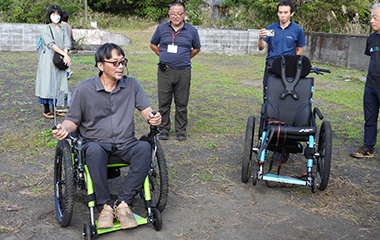
These self-propelled power-assisted offroad wheelchairs, which are provided by the UK-based Mountain Trike Company, dramatically expand the range of activities, including forest trails, walks around town, and strolls through parks. They also offer outstanding drivability thanks to their unique lever system, and they offer the use of power assistance as necessary, such as when climbing hills or traversing nature trails.
4) Power-assisted outdoor assistive wheelchairs (ePush)
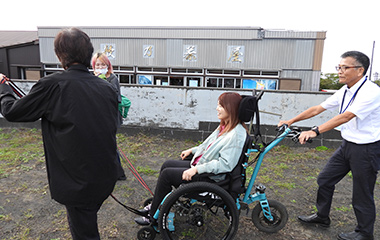
These power-assisted outdoor assistive wheelchairs, which are provided by the UK-based Mountain Trike Company, are generally used by having caregivers push them, as is implied by the name “ePush.” They use an electric motor to provide assistance, which makes it easy for even people who are not particularly strong to push them over various road surfaces.
By suitably combining such assistive devices, we confirmed that it is possible to establish an “accessible movement and experience flow” that ensures the safety of participants and facilitates a smoother experience for them while moving from the meeting place to the course entrance, traversing natural terrain, or staying at the facilities.

Outdoor wheelchairs (HIPPOcampe)

HIPPOcampe

Wheelchair pulling equipment (JINRIKI)

JINRIKI

Power-assisted offroad wheelchairs (eTrike)

eTrike(Left)/ePush(Right)

Power-assisted outdoor assistive wheelchairs (ePush)

ePush

Key points on setting up the necessary environment

When implementing the Oshima trekking experience, it is important not only to prepare assistive devices but also to set up a suitable environment and share information in advance.
・Organize easy-to-understand information on the flow of people to the course, the existence of differences in grade, the distance, the road surface conditions, and similar details. ・To ensure the safety of people with disabilities, advance confirmation is essential to ensure that supporters understand both the safety requirements and difficulty level. ・Confirm the following in advance and provide information on them: shady areas, areas where participants can rest, areas sheltered from the wind, restroom and waiting-area locations, etc. Setting up such an environment serves as a foundation for enabling people to comfortably choose nature experiences while also reducing the anxiety faced by participants and increasing their level of satisfaction.

Implementing management (ensuring enjoyment by both participants and caregivers)

Once the flow of people was prepared, the participants moved to the course entrance with caregivers and staff, and they utilized outdoor wheelchairs and assistive devices as they started walking at a reasonable pace. As they moved, participants were supported by assistants positioned in all directions, who carefully monitored the progress by confirming nearby volcanic lapilli, slopes, the strength of the wind, and other details.
On the day of the event, there was an approximately 20-minute preparatory briefing at the Oshima Onsen Hotel, which included an explanation of the itinerary as well as basic sign language to be used in emergencies, an approximately 40 to 60-minute trip from the departure point to the halfway point, various stops at rest points and scenic spots along the way, and a return trip. All of this took around two hours total. During the tour, factors that included the weather, volcanic-wind strength, and the physical condition of participants were considered to adjust the walking distance and number of rest breaks to achieve a pace reasonable for all the participants.
When participants had the opportunity to stand still in the middle of nature and experience the scenery and feel of the wind and ground, it made them feel like they were personally able to walk, which was a stirring experience for them to share with their caregivers. Gradually adjusting the distance and difficulty level enabled some participants to take on the challenge of full-scale trekking as opposed to a short walk, and, upon experiencing the scenic view from the summit and observation points, some even mentioned that going so far boosted their self-confidence.

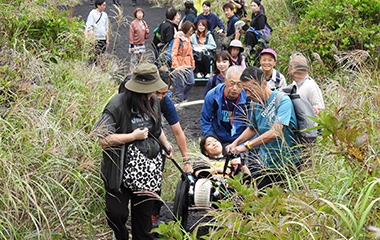
The scene of supporting a wheelchair on a trecking road.

After the trekking experience ended

After the experience ended, the used assistive devices were collected and inspected, and everyone returned to the meeting place while confirming the physical condition of each participant and checking for signs of fatigue. Rest time was also provided as necessary, and the restrooms and waiting areas that were confirmed before the tour were utilized to maintain a safe flow of people after the experience as well.
We then cleaned and set up the equipment to get ready for the next time it will be used. In addition, immediately after the experience, we recorded and shared information on participant feedback and facial expressions as well as anything noticed by the staff, and this will help us make improvements in terms of how future events are managed as well as program quality.

Participant feedback

We received feedback from participants that included the following: “I participated with my daughter, who is in a wheelchair, but I did not think we would be able to climb that road.” “I thought mountain-climbing would be too hard, but we did it even in a wheelchair.” “Being able to look at the same scenery together was such a delight.” We also heard some remarks about future activities: “I want to work on making local areas more accessible.” “The event was a good opportunity to network with like-minded colleagues.” And there were remarks about utilizing the knowledge gained for practical work: “I felt like utilizing wheelchairs could be useful during disasters as well.”
In addition, it was a major realization for travel agencies, local tourism operators, nature-experience guides, and people in charge of receiving customers on site to learn that participants view suitable preparations, the proper use of equipment, the division of roles, and course establishment as important parts of the experience. The event also encouraged some positive changes not only for the participants themselves but also in terms of their relationships with family members and others: “The opportunity to participate as mother and daughter gave me a chance to see the kind of smile I do not normally see.” “It felt like spending quality time with a colleague as opposed to one of us being supported and the other being the supporter.” Site experiences such as the above were ultimately shared as reliable clues in terms of considering future program creation and reception systems.

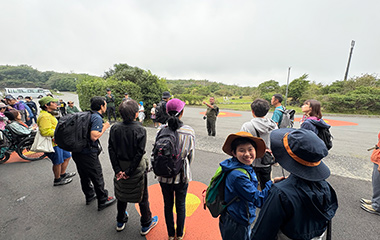
The scene of participants sharing their impressions.

Notes on making arrangements

It is important to comprehensively share information in advance, including the status of participants, necessary considerations, and communication systems used on the day of the event. It is also essential to make mobility adjustments, including arranging means of transportation on the island, securing waiting areas, and formulating operating plans in line with the itinerary. Another key point for safely implementing nature experiences is to share safety management judgment criteria, including frequently confirming the physical condition of participants on the day of the event and assigning staff roles to “avoid imposing undue stress on participants” and “turn back depending on the situation.”

The scene of support provided when boarding a ship in a wheelchair.
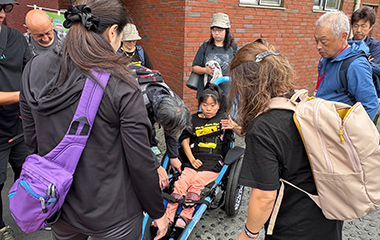
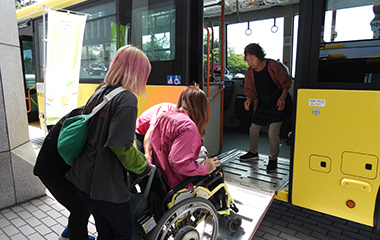
The scene of support provided when boarding a bus in a wheelchair.

Subsidy for Nature Experience Tourism Promotion Project that everyone can enjoy

Outdoor wheelchairs, pulling equipment, and other equipment used for trekking and nature experiences can be introduced by using a subsidy system introduced by Tokyo. This makes it possible to reduce initial costs while improving both safety and the reception system, thereby supporting organizations hoping to enter the experience-based nature tourism business or create related products.
Details: https://www.sangyo-rodo.metro.tokyo.lg.jp/tourism/kakusyu/nature/

This workshop made it clear that even activities once felt to be too difficult can be changed into realistic options with the right preparation and local cooperation. Little on-site realizations and steps can be a major force for making the local natural environment accessible to as many people as possible.
We hope that this experience will help you take the next step in terms of taking on the challenge of developing your own business.

Article List return to
top of
page.