The information you need can be searched for from here

CLOSE ✖
POINT!

Appeal of Oshima nature experiences
Mountains and the earth are not just for viewing from afar. They are places where you can stand and experience nature with your entire body. The Oshima nature-experience program is designed to give people with disabilities, elderly people, and their families and caregivers the opportunity to walk while sharing the same scenery. Thanks to the use of special equipment and support systems, even people who have felt anxious about mountain roads or their footing in the past can safely experience the rich natural environment of the island.

Oshima "Hot Spring Hotel Route"
Trekking Experience Monitor Tour event report

Tokyo is promoting the creation of a tourism environment that enables anyone to safely enjoy nature, including people with disabilities and elderly people. As part of these efforts, a nature-experience trial tour was held in Izu Oshima. This article introduces the event.

Movie

Contents

Overview of the Oshima nature-experience trial tour

On October 2 and 3, as part of its Fiscal 2025 Nature Experience Tourism That Everyone Can Enjoy Promotion Project, Tokyo held the Oshima Trekking Experience Workshop in Izu Oshima (Oshima, Tokyo).
The trial tour’s participants included people with disabilities, their caregivers, travel agency employees, and business operators who provide nature-experience services.
The instructor was the following person in charge of planning trips for elderly people and people with disabilities:
・Mr.Masami Nagahashi,Chairman and Chief Researcher,NPO Universal Tourism Research Institute
This event used an overnight format (two days and one night) and was provided to give participants the opportunity to share a trekking experience and operational methods for the kind of natural environment only found on a volcanic island.

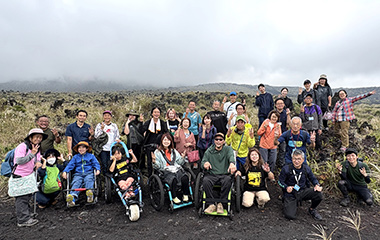
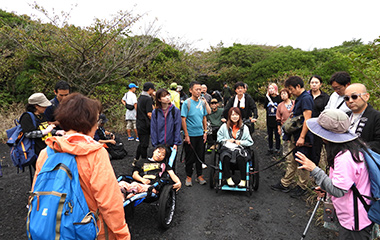
The group photo of the test tour participants.

Event venue

The event venue was Izu Oshima, which is a remote island that can be easily accessed from the Greater Tokyo Area by taking a high-speed jet ferry from the Tokyo Takeshiba Passenger Ship Terminal, a trip that takes around one hour and 45 minutes. Mount Mihara, a symbol of the island, stands at its center, and visitors can expect to experience the kind of dynamic natural environment that can only be found on a volcanic island, including dramatic views of black lava rock, the vast sky, and the sea beyond.
The trekking area around Mount Mihara consists of unpaved paths and gradual hills, but there are also numerous observation decks and rest areas, which makes the location suitable for enjoying the scenery while walking. This site also enables visitors to observe nature while walking and includes views of geological cross-sections, geopark facilities, and other spots where visitors can learn about how volcanoes are formed. One thing that makes Izu Oshima so appealing is that, in spite of the fact that it can be easily accessed by ferry from the city center, it gives visitors the chance to experience the earth on an extraordinary scale. During the recent event, participants trekked along the Oshima Onsen Hotel route, which gave them a chance to enjoy the volcanic island’s unique terrain and scenery. This route starts at the Oshima Onsen Hotel before proceeding to the Vegetation Regeneration Trail. This trail starts with the Sunlight Tunnel in the Shade of Trees, which is essentially a path running through a sea of trees, before transitioning to shrubs, plants, and a grassland area and then shifting to the Road becoming Forest Someday, which leads to the lava area. Beyond this rough lava area lies the Geo Rock Garden, which eventually gives way to the Ura-Sabaku Kaze no Oka (Ura Desert Wind Hill). After passing through this area, visitors find the Ura-Sabaku Desert, an expansive world of blackness.

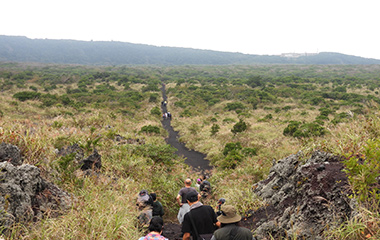
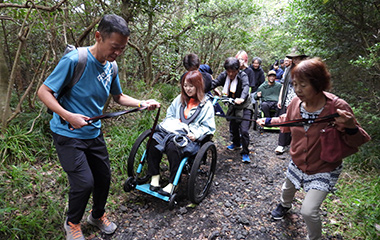
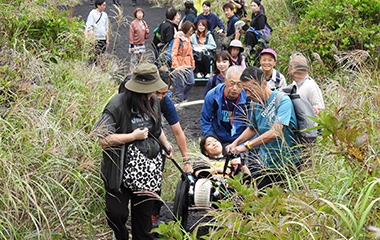
The scene of participants walking along the "Path of Regeneration".

Nature-experience preparations

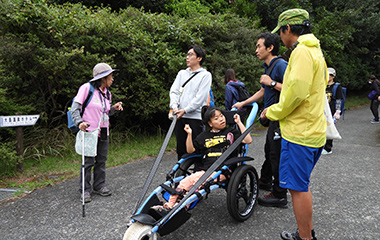
To enable participants to safely walk the volcanic earth and feel more connected to nature during their trekking experience in Oshima, we used special assistive equipment. This equipment was transported to the island in advance in preparation to achieve safe movement and experiences on the day of the event.
The main equipment used during the recent trekking is introduced below.

1) Outdoor wheelchairs (HIPPOcampe)
These outdoor wheelchairs are capable of stably moving in harsh environments that include gravel roads, volcanic lapilli, and unpaved mountain roads, and they are therefore core equipment for supporting movement while trekking. Outdoor wheelchairs:
• Have large, thick tires unlikely to sink in bumpy roads,
• Vibrate little, which helps users feel secure, and
• Boast a design that makes it easy for caregivers to provide support from any direction.
During the event, these wheelchairs provided initial support to help people approach the challenging natural environment in spite of the unsteady footing of the volcanic earth.

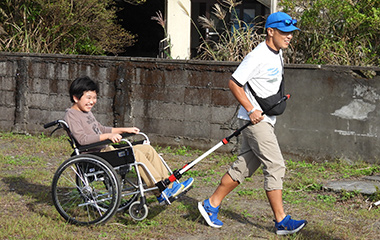
2) Wheelchair pulling equipment (JINRIKI)
This equipment can be attached to wheelchairs and makes it possible to move with little force even on hills and gravel roads by enabling the use of pulling force in addition to pushing. This equipment:
• Is effective in places where it is necessary to go uphill or straight for a long time,
• Lightens the burden imposed on caregivers, and
• Reduces vibrations and enables more stable movement.
During the event, this equipment provided reliable support to help participants more securely navigate the ups and downs of the trekking route.

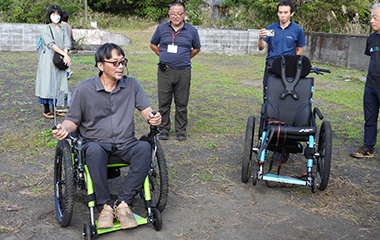
3) Power-assisted offroad wheelchairs (eTrike)
These self-propelled power-assisted offroad wheelchairs, which are provided by the UK-based Mountain Trike Company, dramatically expand the range of activities, including forest trails, walks around town, and strolls through parks. They also offer outstanding drivability thanks to their unique lever system, and they offer the use of power assistance as necessary, such as when climbing hills or traversing nature trails. * In Oshima, these wheelchairs are loaned out via an advance reservation system at the Oshima Tsubaki Refinery.
4) Power-assisted outdoor assistive wheelchairs (ePush)
These power-assisted outdoor assistive wheelchairs, which are provided by the UK-based Mountain Trike Company, are generally used by having caregivers push them, as is implied by the name “ePush.” They use an electric motor to provide assistance, which makes it easy for even people who are not particularly strong to push them over various road surfaces.
* In Oshima, these wheelchairs are loaned out via an advance reservation system at the Oshima Tsubaki Refinery.

Outdoor wheelchairs (HIPPOcampe)

HIPPOcampe

Wheelchair pulling equipment (JINRIKI)

JINRIKI

Power-assisted offroad wheelchairs (eTrike)

eTrike(Left)/ePush(Right)

Enabling everyone to share the joy of walking the earth

Once the preparations were complete, the participants slowly made their way to the trekking course with their caregivers and the staff.
Everyone used outdoor wheelchairs and other assistive devices as they confirmed the nearby gravel and slope while walking at a reasonable pace.
• Multiple people supported each participant, putting safety first as they confirmed the road surface situation and wind strength as needed.
• The basic approach was to take a break after each short section, paying close attention to the physical condition and level of fatigue of participants.

With the black lava rock and sky before them, the participants naturally started smiling as a sense of accomplishment spread among them.
“I did not think I would ever be able to come to a place like this.”
“Being able to view the same scenery together was such a delight.”
Even people who had hesitated to walk on mountain trails finally had the chance to experience the feel of the wind and ground as well as the view of Mount Mihara in the distance, and they shared this special time with their caregivers.
For them, this event changed the earth from scenery to be gazed at from afar to something that can be experienced together, altering how they interact with nature.

The scene of supporting a wheelchair on a trecking road.

The site below introduces accessibility information related to tourist facilities in Oshima.
Be sure to take a look at it as well.
https://www.sangyo-rodo1.metro.tokyo.lg.jp/tourism/accessible/en/islands/oshima.html

Main Page return to
top of
page.