The information you need can be searched for from here

CLOSE ✖
POINT!

Appeal of accessible beaches
The sea is not just for viewing. It is a place to be experienced with your own body.
Accessible beaches are designed to give people with disabilities, elderly people, and their families and caregivers the opportunity to enjoy the sea together.
Thanks to the use of special equipment and support systems, even people who felt like entering the sea would be difficult can safely experience such natural environments.

Hachijojima Accessible Beach and Snorkeling Experience Report

Tokyo is promoting the creation of a tourism environment that enables anyone to safely enjoy nature, including people with disabilities and elderly people. As part of these efforts, an accessible-beach trial tour was held at Sokodo Beach in Hachijojima. This article introduces the event.

Movie

Contents

Overview of Hachijojima Accessible Beach

On July 10 and 11, as part of its Fiscal 2025 Nature Experience Tourism That Everyone Can Enjoy Promotion Project, Tokyo held the Hachijojima Accessible Beach Management Experience Workshop in Hachijojima (Hachijo, Tokyo).
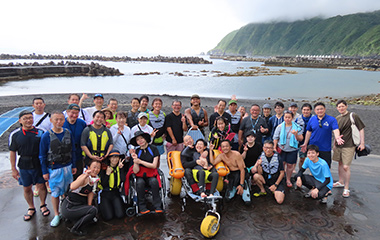
The trial tour’s participants included people with disabilities, their caregivers, travel agency employees, and business operators who provide nature-experience services.
The instructors were the following creators of accessible beaches throughout Japan:
・Mr. Masahiro Sakakibara, Chairperson, Shonan Barrier-Free Tour Center
・Ms. Yuriko Orui, Representative, Hachijojima Nature Guide Service Shinoki
This training and experience used an overnight format (two days and one night).

The group photo of test tour participants in accessible beach.

Event venue

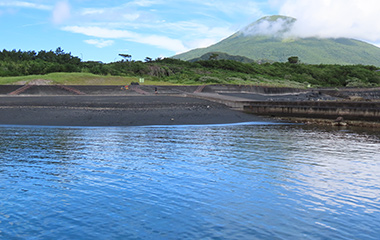
The event venue was Sokodo Beach, a major Hachijojima beach located around ten minutes away from the airport by car and right next to the Tokai Kisen Sokodo Port.
This gently sloping beach has calm waves and nearby showers and restrooms, making it ideal for a walk on the seashore.
However, the changing room has stairs, so wheelchair users are advised to use the facilities at the nearby Sokodo Campsite.
Another thing that makes the beach attractive is its good location, which is only about an hour from Haneda Airport by plane.

The scenery of the Sokodo Beach.

Preparing the accessible beach

To enable participants to safely approach and enter the sea during the accessible beach event, we used special equipment. This equipment was transported to Hachijojima from the Port of Tokyo by using a Tokai Kisen cruise ship.
The three main kinds of equipment used during this event are introduced below.
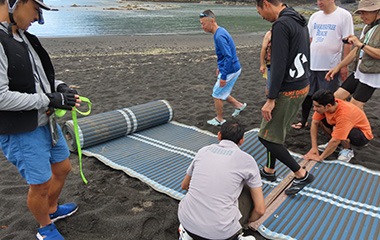
1) Access mats (Mobi-Mat)
These mats are used to enable movement on beaches and over other rough terrain, and they can be used to create a path that enables movement to the water’s edge without sinking even in the case of wheelchairs or baby strollers. Access mats:
・Have a mesh structure that makes it unlikely for them to sink into the sand, ・Are unlikely to cause even people who have trouble walking to trip, and ・Offer enough width to enable caregivers to walk alongside the people they help. Access mats eliminate a key difficulty caused by beaches and are therefore an important first step in approaching the sea.
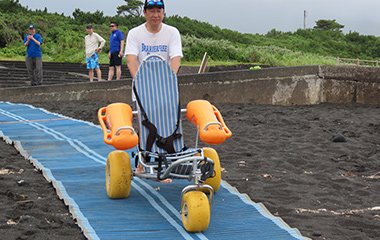
2) Amphibious wheelchairs (Mobi-Chair)
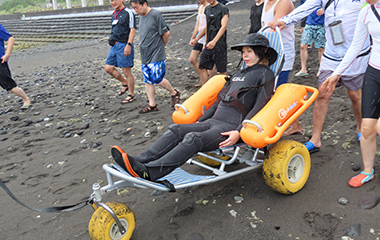
These special amphibious wheelchairs can be used both on land and in the water. They float on the surface of the sea to offer users the ability to directly enter and experience it. Amphibious wheelchairs:
・Have highly buoyant wheels and armrests, ・Can smoothly move from the beach to the sea, and ・Give users the chance to directly experience the buoyancy of the sea with their entire body. Unlike normal wheelchairs, amphibious wheelchairs gave participants the opportunity to safely enjoy the feeling of floating in the sea during the event.
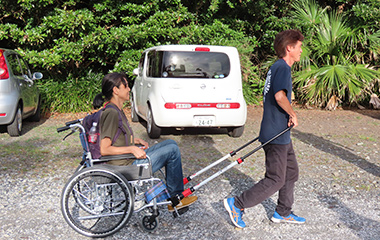
3) Wheelchair pulling equipment (JINRIKI)
This pulling equipment can be easily attached to wheelchairs and makes it possible to move even on hills and gravel roads with little force. This equipment:
・Is effective in places where pushing is difficult, ・Lightens the burden imposed on caregivers, and ・Reduces vibrations and enables safer movement. During the event, this equipment was especially effective for helping participants navigate the ups and downs of Hachijojima’s road to the sea.
Snorkeling experience preparations
During the recent event, instead of just entering the sea, even participants in wheelchairs had the chance to take on the challenge of snorkeling.
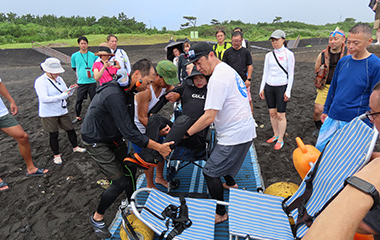
Wetsuits are worn to ensure buoyancy and safety when snorkeling, but they can be difficult to put on or take off.
The staff members and caregivers therefore collaborated to provide careful support to participants without putting excessive stress on them.
After putting on a wetsuit, each participant’s mask and flippers were also adjusted so they could experience snorkeling, floating in the sea while looking at fish.

Access mats (Mobi-Mat)

Mobi-mat

Amphibious wheelchairs (Mobi-Chair)

Mobi-Chair

Wheelchair pulling equipment (JINRIKI)

JINRIKI

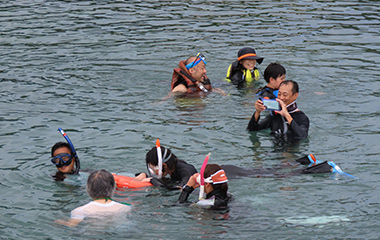
The scene of snorkeling.

Enabling everyone to share the joy of entering the sea

Once the preparations were complete, the participants slowly made their way to the water’s edge along with their caregivers and the staff.
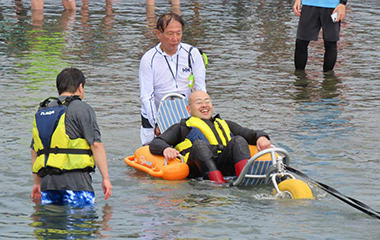
Everyone used amphibious wheelchairs and personal flotation devices as they confirmed the sea conditions while carefully entering the water.
・Multiple people supported each participant, putting safety first as they confirmed the waves and tidal current as needed. ・The basic approach was to provide multiple short experiences that did not put undue stress on participants, paying close attention to their physical condition and level of fatigue. Once they were floating in the sea, the participants all started smiling as a sense of joy spread among them.
“I always thought entering the sea would be too hard for me, but I managed to relax and enjoy the experience.”
“Even the caregivers found themselves smiling.”
Even people who had given up on the sea for a long time finally had the chance to actually experience how good the sea can feel, and they were able to share happy time with their caregivers.
For them, this event changed the sea from “a place to be looked at” to “a place to be enjoyed together,” giving them the opportunity to experience the true value of the sea.

The scene of riding in an amphibious wheelchair (MobiChair).
The scene of moving around the beach in an amphibious wheelchair (MobiChair).
The scene of entering the sea in an Amphibious wheelchairs (Mobi-Chair).

The site below introduces accessibility information related to tourist facilities in Hachijojima.
Be sure to take a look at it as well.
https://www.sangyo-rodo1.metro.tokyo.lg.jp/tourism/accessible/en/islands/hachijojima.html

Main Page return to
top of
page.