

- TOP >
- Airport Transport Service Co., Ltd. Initiatives
Airport Transport Service Co., Ltd. Initiatives 42-1 Nihonbashi-Hakozakicho, Chuo-ku, Tokyo
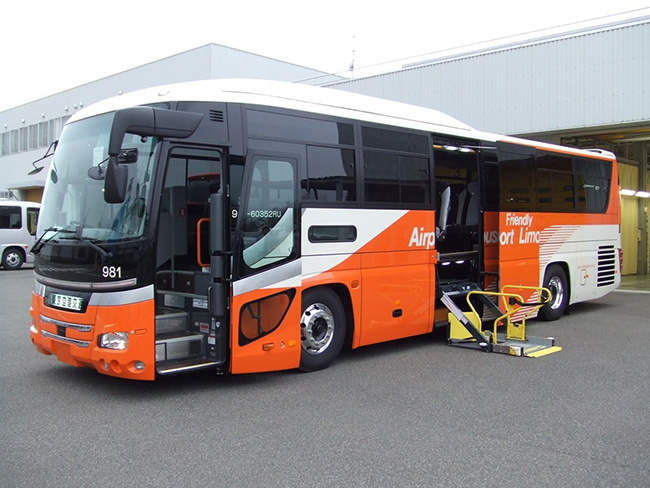 Full view of a lift-equipped limousine bus
 Full view of an elevator-equipped limousine bus
Airport Transport Service Co., Ltd. operates Airport Limousine Bus services connecting central Tokyo and the surrounding areas with Narita Airport and Haneda Airport. The company runs approximately 870 buses per day and is widely known as a vital piece of transportation infrastructure supporting airport access.
In recent years, the company has been working to make accessible tourism a reality, with the goal of ensuring that everyone can use its services with confidence, including wheelchair users, elderly passengers, and persons with physical disabilities. Its current fleet of shared-ride and charter buses includes 14 lift-equipped buses and 11 elevator-equipped buses.
For this article, we spoke with Ms. Nogawa, Mr. Kobori, and Mr. Ito from the company.
Full view of a lift-equipped limousine bus
Full view of an elevator-equipped limousine bus
“Friendly for All”: Start by Removing the Barriers in People’s Hearts
The company’s commitment to accessibility began with its “Friendly” philosophy, established in 1998 and centered on being gentle, considerate, and courteous. Under the motto “Ensuring that our commitment reaches every customer,” the company first focused on improving the human side of its operations, particularly how staff interact with and assist customers.
Starting in 2016, all employees, including bus drivers and passenger service agents, were required to complete a basic Service Care-Fitter certification course. The company also worked to create a more welcoming environment for international travelers by installing multilingual in-vehicle information displays, automated ticket vending machines, and bus stop signage.
In the lead-up to the Tokyo 2020 Olympic and Paralympic Games, the entire company devoted itself to improving service based on the “Friendly for All” philosophy, investing in staff development and training programs to deepen understanding of the needs and perspectives of elderly individuals and persons with disabilities.
However, the COVID-19 pandemic forced the company to suspend some of its training and certification programs.
The Olympic and Paralympic Games as a Catalyst for Lift-Equipped Buses
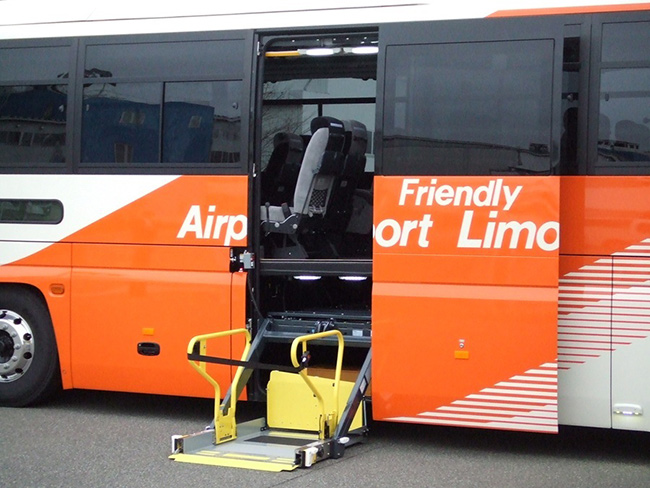 Lift-equipped limousine bus (lift in lowered position)
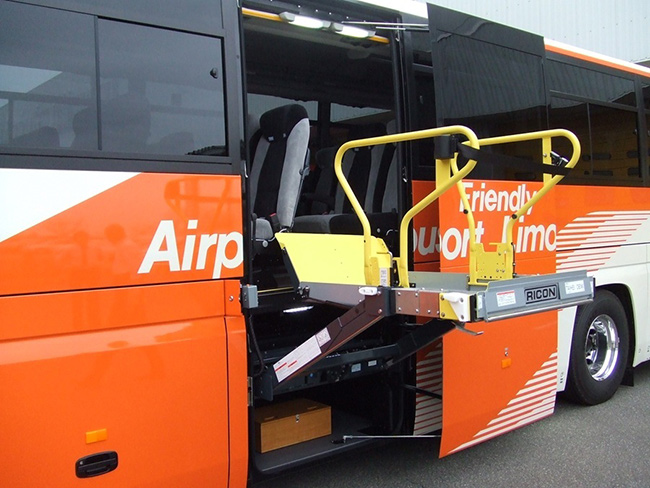 Lift-equipped limousine bus (lift in raised position)
The announcement that Tokyo would host the 2020 Olympic and Paralympic Games gave a major boost to the company’s accessibility efforts. Until then, the primary role of limousine buses had been to transport passengers with large luggage directly to the airport. The Games, however, were expected to bring a large number of travelers with physical disabilities, including wheelchair users, to Japan by air.
In response, the Tokyo Metropolitan Government created the Tourism Bus Accessibility Support Subsidy in 2016. Following a pilot deployment of one lift-equipped bus in March 2016 with funding from the national and metropolitan governments, the company used this subsidy program to introduce one additional lift-equipped bus in 2016 and two more in 2017.
Lift-equipped buses offer the major benefit of allowing wheelchair users to board safely without leaving their wheelchairs, and when no wheelchair passengers are present, the space can be used as regular seating. At the same time, a number of operational challenges emerged: each lift cycle takes approximately five to eight minutes; the lift requires open space alongside the bus to deploy; securing wheelchairs inside the cabin is time-consuming; rain and wind enter the cabin while the lift is in use; the lift cannot operate at standard covered bus stops; and some wheelchair users feel uneasy about being raised or lowered outside the vehicle.
To mitigate these challenges as much as possible, the company surveyed and selected bus stops where the lift could be deployed with minimal exposure to rain and wind, and conducted training for passenger service agents to ensure the smooth guidance and securing of wheelchair passengers onboard. In addition, to help ease any anxiety or fear passengers may have about being raised or lowered outside the vehicle, staff were instructed to speak to passengers attentively during boarding and alighting, ensuring they could use the service with confidence.
Lift-equipped limousine bus (lift in lowered position)
Lift-equipped limousine bus (lift in raised position)
Joint Development of the Elevator-Equipped Bus
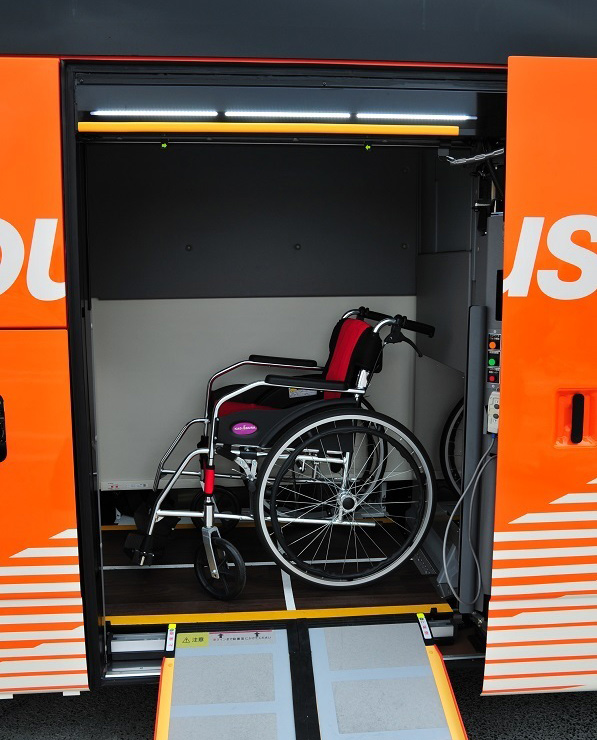 Elevator-equipped limousine bus(elevator entrance)
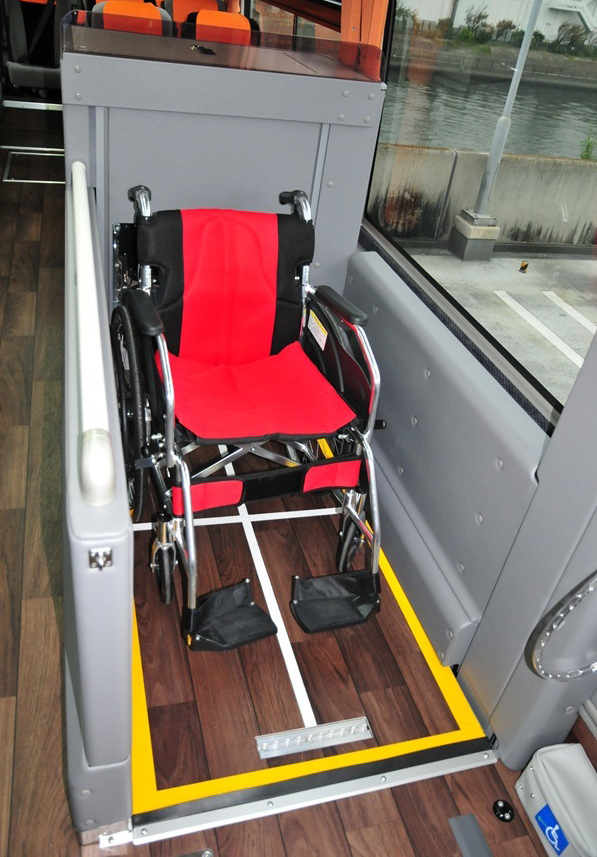 Elevator-equipped limousine bus(elevator in raised position)
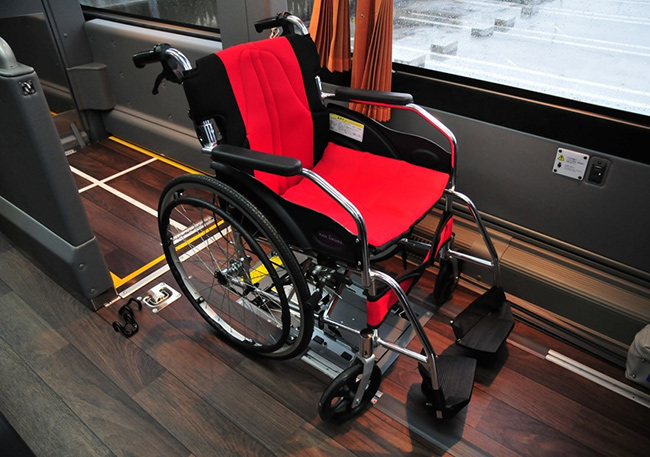 Elevator-equipped limousine bus(wheelchair securing area)
To solve these problems, Mitsubishi Fuso Truck and Bus Corporation (MFTBC) approached the company in 2015 with a new concept. The idea was to develop a bus with a built-in elevator. In this design, passengers board via a ramp and then ride an elevator installed inside the bus up to the cabin floor. Another notable feature is that the vehicle is easy to use even in rainy weather, retains luggage storage capacity, does not require large amounts of space outside the bus, and is equipped with a device that makes securing wheelchairs simpler.
The company partnered with MFTBC on the joint development, completing a prototype in 2017; after gathering input from wheelchair users, disability advocacy groups, and frontline staff and making repeated improvements, the production model of the elevator-equipped bus was completed in 2018.
Although seating capacity is reduced by approximately six seats compared to a standard vehicle, the shorter boarding and alighting times and reduced impact from weather were highly valued, and seven elevator-equipped buses were introduced in 2019. An integrated accessible vehicle fleet, combining both lift-equipped and elevator-equipped buses, is now in operation.
Currently, as the company has not yet fully recovered from the pandemic-era service reductions and the loss of bus drivers and passenger service agents, elevator-equipped buses operate two round trips per day between Haneda Airport and Narita Airport. At the time of introduction, the subsidy covered the cost difference between standard and accessible vehicles; even then (as of 2018), the additional cost was approximately 4 million yen for a lift-equipped bus and approximately 8 million yen for an elevator-equipped bus.
Elevator-equipped limousine bus(elevator entrance)
Elevator-equipped limousine bus(elevator in raised position)
Elevator-equipped limousine bus(wheelchair securing area)
Post-Introduction Results and Challenges
The company’s initiatives have become a reference for other bus operators, and the expansion of stops where elevator-equipped buses can be deployed, the increased range of routes and manufacturer options, and features better suited to shared-ride operations have all been positively received by operators and users alike. Passengers have shared feedback such as “there are thoughtful touches throughout, making boarding and alighting feel safe and reassuring” and “the view is better than on the buses I usually ride, making travel more enjoyable.” Across the country, adoption is now progressing on airport shuttle buses, highway express buses, and similar services. Other manufacturers have also become more aware of the need and are putting more effort into improvements.
It should also be noted that due to the limited space inside the vehicle, the company recommends advance reservations for both elevator-equipped and lift-equipped buses; however, some passengers have noted that “it feels safe and reassuring to use on the day.”
On the other hand, usage by international visitors is still relatively low, and a lack of public awareness is considered one of the key issues.
The COVID-19 pandemic also had a significant financial impact, with the postponement of the Tokyo 2020 Olympic and Paralympic Games and a sharp drop in ridership leading to difficult circumstances, including the departure of experienced bus drivers. Even so, the company is now gradually recovering and has reached a new starting point.
It is currently exploring ways to make more effective use of these buses, including adjustments to operating schedules, measures to boost ridership, driver training, and improvements to working conditions. Because this work is directly connected to safe operations, the company approaches it with the utmost seriousness.
Future Outlook
The company believes that a barrier-free mindset among staff is just as important as physical infrastructure and technology. Rather than relying only on frontline staff trained to operate lifts and elevators, the company says it is essential to foster a workplace culture where every employee can respond to passengers’ needs. Thinking from the passenger’s perspective and continually refining the experience so that every rider can enjoy the service in comfort. The company believes this is the essence of truly universal service, and the key to safe, enjoyable travel.
Ridership, which fell sharply during the pandemic, is gradually returning. Going forward, the company plans to expand awareness through online outreach and various other initiatives, with the goal of growing ridership. It will also continue exchanging information with regional airports and other stakeholders, seeking to provide more travel opportunities for all passengers, wheelchair users and non-wheelchair users alike, and working to make airport access easy for everyone to use.

 social media accounts
Tokyo, a city that is accessible everywhere to anyone.
Sightseeing where you wish, as you wish.
This ability to travel anywhere you please makes life that much richer.
Tokyo welcomes your visit.
Here you can encounter tradition,
history, culture, nature, technology,
and, best of all, smiling faces.
Making tourism closer and more
enjoyable through accessible tourism.
